

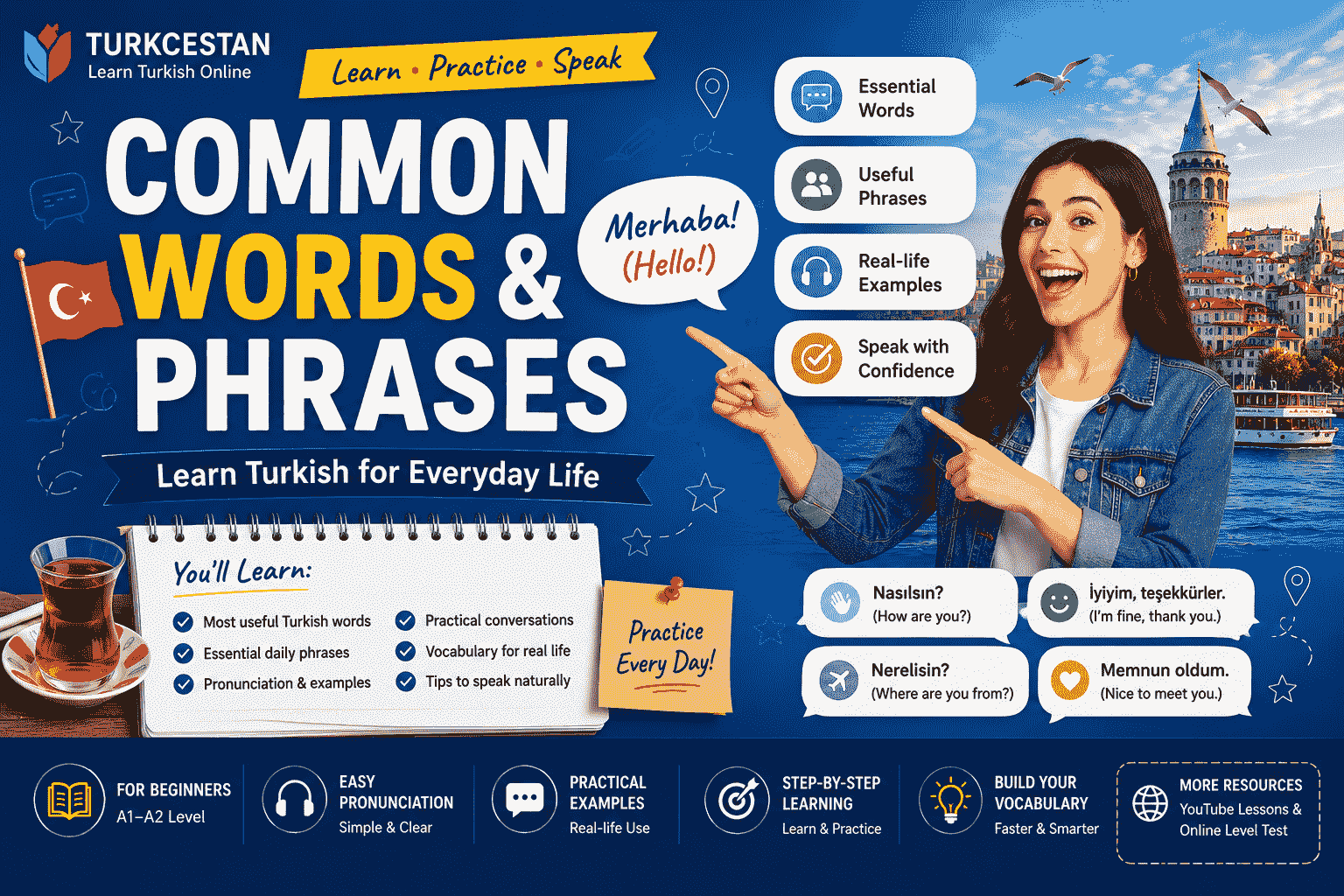
Common Turkish Words & Phrases Every Beginner Should Know
Learning the most common Turkish words and phrases is the fastest way to start communicating in everyday situations. Instead of memorizing hundreds of random vocabulary items, focus on the expressions Turkish people use every day.
In this complete guide, you’ll learn essential Turkish greetings, polite expressions, everyday questions, shopping vocabulary, restaurant phrases, travel expressions, and practical conversations that you can start using immediately.
Whether you’re visiting Türkiye, studying Turkish, or preparing for a Turkish language exam, these common Turkish words and phrases will help you speak more naturally and confidently.
Why Learn Common Turkish Words First?
Many beginners spend months studying grammar before speaking. Native speakers do the opposite—they learn useful expressions first.
Learning high-frequency vocabulary allows you to:
- ✔ Understand everyday conversations
- ✔ Ask simple questions
- ✔ Order food
- ✔ Introduce yourself
- ✔ Travel around Türkiye
- ✔ Build confidence from day one
Even learning the first 200 Turkish words can help you understand a large percentage of daily conversations.
Essential Turkish Greetings
| Turkish | English | When to Use |
|---|---|---|
| Merhaba | Hello | Any time |
| Selam | Hi | Informal |
| Günaydın | Good morning | Morning |
| İyi günler | Good day | Daytime |
| İyi akşamlar | Good evening | Evening |
| İyi geceler | Good night | Before sleeping |
Pronunciation Tip
Unlike English, Turkish words are pronounced almost exactly as they are written. Once you learn the Turkish alphabet, reading becomes much easier.
New to Turkish pronunciation? Read our complete Turkish Alphabet & Pronunciation Guide.
Polite Turkish Expressions
| Turkish | English |
|---|---|
| Lütfen | Please |
| Teşekkür ederim | Thank you |
| Rica ederim | You’re welcome |
| Affedersiniz | Excuse me |
| Özür dilerim | I’m sorry |
| Sorun değil | No problem |
Introducing Yourself in Turkish
These are among the first Turkish phrases every learner should memorize.
| Turkish | English |
|---|---|
| Ben David. | I’m David. |
| Ben İngiltere’den geldim. | I’m from England. |
| Türkçe öğreniyorum. | I’m learning Turkish. |
| Memnun oldum. | Nice to meet you. |
| Sizin adınız ne? | What’s your name? |
Mini Dialogue
A: Merhaba!
B: Merhaba! Nasılsınız?
A: İyiyim, teşekkür ederim.
B: Ben de iyiyim.
A: Memnun oldum.
B: Ben de memnun oldum.
Did You Know?
Many Turkish greetings change depending on the time of day. Using the correct greeting makes your Turkish sound much more natural and helps you communicate like a native speaker.
Common Turkish Words for Shopping
Shopping is one of the easiest ways to practice Turkish. Whether you’re visiting a local market, a supermarket, or a shopping mall, these useful Turkish words and phrases will help you communicate confidently.
| Turkish | English |
|---|---|
| Ne kadar? | How much is it? |
| Çok pahalı. | It’s very expensive. |
| Daha ucuzu var mı? | Do you have a cheaper one? |
| İndirim var mı? | Is there a discount? |
| Deneyebilir miyim? | May I try it on? |
| Alıyorum. | I’ll take it. |
| Teşekkür ederim. | Thank you. |
Useful Turkish Words at a Restaurant
Turkish cuisine is famous around the world. Knowing a few restaurant phrases will make your dining experience much easier.
| Turkish | English |
|---|---|
| Menü lütfen. | Menu, please. |
| Su alabilir miyim? | May I have some water? |
| Çay istiyorum. | I would like tea. |
| Kahve alabilir miyim? | Can I have coffee? |
| Hesap lütfen. | The bill, please. |
| Çok lezzetli. | Very delicious. |
| Afiyet olsun. | Enjoy your meal. |
Popular Turkish Food Vocabulary
| Turkish | English |
|---|---|
| Ekmek | Bread |
| Peynir | Cheese |
| Yoğurt | Yogurt |
| Kebap | Kebab |
| Pilav | Rice |
| Çorba | Soup |
| Tatlı | Dessert |
| Su | Water |
| Çay | Tea |
| Kahve | Coffee |
Asking for Directions in Turkish
When travelling in Türkiye, you’ll often need to ask for directions. These expressions are among the most useful Turkish phrases for beginners.
| Turkish | English |
|---|---|
| Affedersiniz. | Excuse me. |
| Nerede? | Where is…? |
| Otobüs durağı nerede? | Where is the bus stop? |
| Metro nerede? | Where is the metro? |
| Sağa dönün. | Turn right. |
| Sola dönün. | Turn left. |
| Düz gidin. | Go straight. |
Numbers You Should Know
Numbers are essential for shopping, travelling, telling the time, and understanding prices.
| Number | Turkish |
|---|---|
| 1 | Bir |
| 2 | İki |
| 3 | Üç |
| 4 | Dört |
| 5 | Beş |
| 6 | Altı |
| 7 | Yedi |
| 8 | Sekiz |
| 9 | Dokuz |
| 10 | On |
Talking About Time
| Turkish | English |
|---|---|
| Saat kaç? | What time is it? |
| Bugün | Today |
| Yarın | Tomorrow |
| Dün | Yesterday |
| Sabah | Morning |
| Öğleden sonra | Afternoon |
| Akşam | Evening |
| Gece | Night |
Emergency Turkish Phrases
Although you may never need them, it’s useful to know a few emergency expressions.
| Turkish | English |
|---|---|
| Yardım edin! | Help! |
| Doktor lazım. | I need a doctor. |
| Polisi arayın. | Call the police. |
| Hastane nerede? | Where is the hospital? |
| Anlamıyorum. | I don’t understand. |
| Daha yavaş konuşur musunuz? | Could you speak more slowly? |
Practice Challenge
Try using at least 10 new Turkish words today. Introduce yourself, order a coffee, ask for directions, or greet someone in Turkish. Small daily practice sessions help you remember vocabulary much faster than memorizing long word lists.
Learning Tip
Instead of learning single words, learn complete phrases such as “Teşekkür ederim”, “Ne kadar?”, or “Memnun oldum.” Native speakers think in phrases, not isolated vocabulary.
Common Beginner Mistakes When Learning Turkish
Every language learner makes mistakes, and that’s completely normal. The important thing is to recognize them early and build good habits from the beginning.
❌ Translating Every Word
Turkish sentence structure is different from English. Instead of translating word by word, learn complete expressions and short sentences.
Example:
❌ Incorrect thinking: “I coffee drink”
✅ Turkish: Ben kahve içerim.
❌ Ignoring Pronunciation
Turkish is a phonetic language. Every letter has a consistent pronunciation. Learning the alphabet first will improve both your speaking and listening skills.
❌ Memorizing Random Vocabulary
Learning isolated words is much harder than learning vocabulary by topic. Study words related to greetings, food, travel, shopping, and everyday conversations.
Did You Know?
Turkish is spoken by more than 85 million native speakers and millions more around the world.
Unlike English, Turkish words are pronounced almost exactly as they are written, making reading much easier once you learn the alphabet.
Turkish also has a very logical grammar system with relatively few exceptions compared to many European languages.
How to Remember Turkish Vocabulary Faster
Learning vocabulary doesn’t have to be difficult. Try these proven techniques:
- ✅ Learn words in categories instead of random lists.
- ✅ Practice for 10–15 minutes every day.
- ✅ Listen to native Turkish speakers regularly.
- ✅ Repeat words aloud to improve pronunciation.
- ✅ Use new vocabulary in your own sentences.
- ✅ Review old words before learning new ones.
Consistency is much more important than studying for many hours once a week.
Quick Quiz
1. What does “Teşekkür ederim” mean?
A) Hello
B) Thank you
C) Goodbye
Answer: B
2. Which greeting is used in the morning?
A) İyi akşamlar
B) Günaydın
C) Hoşça kal
Answer: B
3. What does “Ne kadar?” mean?
A) Where?
B) How much?
C) Who?
Answer: B
4. What is the Turkish word for “Bread”?
A) Su
B) Kahve
C) Ekmek
Answer: C
5. Which phrase means “Nice to meet you”?
A) Memnun oldum.
B) Lütfen.
C) Rica ederim.
Answer: A
Your 15-Minute Daily Turkish Study Plan
| Time | Activity |
|---|---|
| 5 minutes | Review yesterday’s vocabulary. |
| 5 minutes | Learn 10 new Turkish words or phrases. |
| 5 minutes | Read them aloud and create simple sentences. |
Following this simple routine every day can help you build a strong Turkish vocabulary much faster than occasional long study sessions.
Frequently Asked Questions (FAQ)
How many Turkish words should a beginner learn first?
Learning the first 300–500 common Turkish words is enough to understand many everyday conversations and build a solid foundation.
Is Turkish difficult to learn?
Turkish may look unfamiliar at first, but it has very consistent pronunciation and logical grammar rules. With regular practice, beginners usually make steady progress.
How long does it take to learn basic Turkish?
If you study 15–30 minutes every day, most learners can reach basic conversational Turkish within a few months.
Should I learn grammar or vocabulary first?
Begin with useful vocabulary and everyday expressions. As your vocabulary grows, grammar becomes much easier to understand.
Continue Your Turkish Learning Journey
Now that you’ve learned some of the most common Turkish words and phrases, it’s time to continue improving your Turkish with our free learning resources.
Free Online Turkish Level Test
Find your current Turkish level and discover which lessons you should study next.
Take the Free Online Turkish Level Test →
Learn Turkish on YouTube
Watch free Turkish lessons, pronunciation practice, grammar explanations, listening activities, and real-life conversations.
Continue Reading
- Turkish Alphabet & Pronunciation
- Beginner’s Guide to Learning Turkish
- Turkish Grammar Basics
- Turkish Listening Practice
- Free Turkish Exercises
Conclusion
Learning common Turkish words and phrases is one of the fastest ways to start speaking confidently. Instead of memorizing long vocabulary lists, focus on the expressions you’ll use every day. Practice a little each day, listen to native speakers, and don’t be afraid to make mistakes.
At TURKCESTAN, our goal is to make learning Turkish practical, enjoyable, and accessible for everyone. Explore our free lessons, improve your vocabulary step by step, and enjoy your Turkish learning journey.
Continue Learning Turkish
Excellent! You’ve learned many common Turkish words and everyday expressions.
Now it’s time to understand how Turkish sentences work by learning the basics of Turkish grammar.
⬅ Previous Lesson
Turkish Alphabet & Pronunciation
Review the Turkish alphabet, pronunciation rules, and the unique sounds of Turkish.
➡ Next Lesson
Turkish Grammar Basics
Learn the essential grammar rules, sentence patterns, and core structures that every Turkish learner should know.