

Turkish Grammar Basics – A Beginner’s Guide with Easy Examples
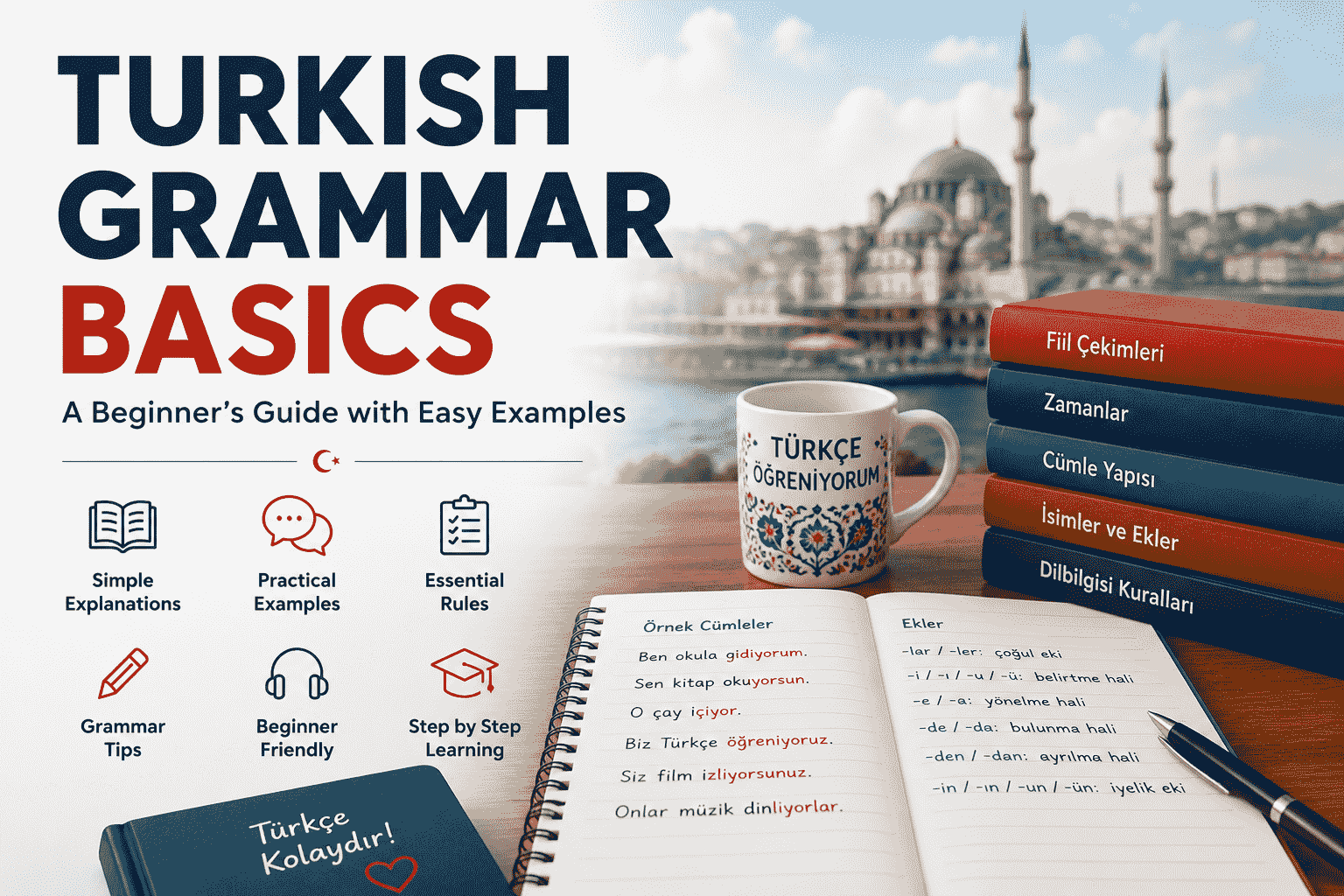
Turkish Grammar Basics provide the foundation for speaking and understanding Turkish correctly. Although Turkish may look different from English at first, it follows logical patterns with very few irregular rules. Once you understand sentence structure, verb endings, and suffixes, building correct sentences becomes much simpler.
This comprehensive guide introduces the most important Turkish grammar rules for beginners. You’ll learn how Turkish sentences are formed, how nouns and pronouns work, and why Turkish grammar is considered one of the most systematic language systems in the world.
Whether you’re learning Turkish for travel, work, university, or daily communication, mastering these grammar basics will help you speak more confidently and understand Turkish more naturally.
What Is Turkish Grammar?
Turkish grammar is the system of rules that explains how words are combined to create meaningful sentences. Unlike English, Turkish relies heavily on suffixes rather than separate helper words.
Instead of changing the root of a word, Turkish usually adds endings that express:
- Plural forms
- Possession
- Location
- Direction
- Verb tense
- Negation
- Questions
This makes Turkish highly consistent and predictable once you understand the basic patterns.
For example:
| English | Turkish |
|---|---|
| house | ev |
| houses | evler |
| at home | evde |
| from home | evden |
| to home | eve |
Notice that the root word ev never changes. Only the suffix changes its meaning.
This simple structure is one of the reasons why many learners eventually find Turkish grammar easier than expected.
Why Learning Turkish Grammar Matters
Many beginners focus mainly on vocabulary. While vocabulary is essential, grammar is what allows you to use those words correctly.
A solid understanding of Turkish grammar helps you:
✔ Build accurate sentences
✔ Speak more naturally
✔ Understand conversations more easily
✔ Improve reading and listening skills
✔ Write with confidence
✔ Prepare for Turkish language proficiency exams
Learning grammar doesn’t mean memorizing complicated rules. Instead, it means recognizing patterns that you will use every day.
Is Turkish Grammar Difficult?
One of the biggest myths about Turkish is that its grammar is extremely difficult.
The reality is quite different.
Turkish belongs to the Turkic language family, so its structure differs from English and many European languages. However, it follows remarkably consistent rules and contains very few irregular forms.
Once you learn a grammar pattern, you can usually apply it to hundreds of other words without exceptions.
This consistency makes Turkish one of the most logical languages to learn.
The Basic Structure of Turkish Sentences
Every language has its own sentence order.
English usually follows:
Subject + Verb + Object
Example:
I drink coffee.
Turkish normally follows:
Subject + Object + Verb
Example:
Ben kahve içerim.
Literally:
I coffee drink.
At first, this order may feel unusual for English speakers. However, after a short period of practice, it becomes natural.
Here are some examples:
| English | Turkish |
|---|---|
| I read a book. | Ben kitap okurum. |
| She drinks tea. | O çay içer. |
| We learn Turkish. | Biz Türkçe öğreniyoruz. |
| They watch television. | Onlar televizyon izliyor. |
| He likes music. | O müziği sever. |
One important rule to remember is that the verb usually comes at the end of the sentence.
This simple principle will help you create correct Turkish sentences from your very first lesson.
Subject, Object and Verb
Let’s look more closely at how Turkish sentences are organized.
| Sentence Part | Turkish Example | English |
|---|---|---|
| Subject | Ben | I |
| Object | kahve | coffee |
| Verb | içerim | drink |
Complete sentence:
Ben kahve içerim.
Another example:
| Sentence Part | Turkish Example | English |
|---|---|---|
| Subject | Biz | We |
| Object | Türkçe | Turkish |
| Verb | öğreniyoruz | are learning |
Complete sentence:
Biz Türkçe öğreniyoruz.
Once you understand this pattern, creating longer sentences becomes much easier.
Personal Pronouns
Before learning verb conjugation, you should become familiar with Turkish personal pronouns.
| English | Turkish |
|---|---|
| I | Ben |
| You | Sen |
| He / She / It | O |
| We | Biz |
| You (plural/formal) | Siz |
| They | Onlar |
Unlike English, Turkish often omits personal pronouns because the verb ending already shows who performs the action.
For example:
Geliyorum.
means
I am coming.
The word Ben is unnecessary because the ending -yorum already indicates the first person singular.
This feature makes spoken Turkish shorter and more natural.
Quick Tip
Instead of translating every sentence word by word from English, try learning complete sentence patterns.
For example, don’t memorize only the verb:
gitmek = to go
Learn the entire sentence instead:
Ben okula gidiyorum.
When you study complete examples, grammar becomes much easier to remember and use in real conversations.
Common Beginner Mistake
Many English speakers naturally place the verb in the middle of the sentence because they follow English word order.
For example, learners sometimes try to translate:
Ben içerim kahve. ❌
The correct Turkish sentence is:
Ben kahve içerim. ✅
Keeping the verb at the end is one of the most important habits you should develop from the beginning.
Did You Know?
Turkish is often described as one of the world’s most logical languages because its grammar follows consistent rules with very few irregular exceptions. Once you understand how suffixes work, you’ll be able to create hundreds of new sentences simply by applying the same grammar patterns.
What’s Next?
Now that you understand the basic structure of Turkish grammar, you’re ready to learn how Turkish nouns, plural forms, cases, and verb tenses work together.
In the next section, we’ll explore the building blocks of Turkish grammar and show you how to form natural sentences used in everyday communication.
Turkish Nouns
Every Turkish sentence begins with nouns. A noun is simply the name of a person, place, object, or idea.
Here are some common Turkish nouns every beginner should know.
| English | Turkish |
|---|---|
| house | ev |
| book | kitap |
| school | okul |
| teacher | öğretmen |
| student | öğrenci |
| city | şehir |
| friend | arkadaş |
| family | aile |
| coffee | kahve |
| water | su |
Unlike English, Turkish nouns do not have grammatical gender.
For example, the pronoun “o” can mean:
- he
- she
- it
The meaning becomes clear from the context.
This makes Turkish simpler than many European languages.
Singular and Plural Nouns
Making nouns plural is very easy.
Turkish uses only two plural suffixes:
- -ler
- -lar
The choice depends on vowel harmony, one of the most important rules in Turkish pronunciation and grammar.
Examples:
| Singular | Plural |
|---|---|
| kitap | kitaplar |
| ev | evler |
| öğrenci | öğrenciler |
| araba | arabalar |
| okul | okullar |
| şehir | şehirler |
Fortunately, learners do not need to memorize each plural form individually. Once you understand vowel harmony, choosing the correct suffix becomes natural.
One Important Rule
Unlike English, Turkish usually does not use the plural suffix after numbers.
English:
Three books
Turkish:
Üç kitap ✅
NOT
Üç kitaplar ❌
More examples:
| English | Turkish |
|---|---|
| five students | beş öğrenci |
| two teachers | iki öğretmen |
| ten houses | on ev |
This is one of the first grammar rules every learner should remember.
Definite and Indefinite Meaning
English uses articles such as:
- a
- an
- the
Turkish has no direct equivalent.
Instead, meaning is understood from the sentence.
Example:
Kitap okuyorum.
This may mean:
I am reading a book.
or
I am reading the book.
Context tells the listener which meaning is intended.
Because of this, Turkish sentences are often shorter and simpler.
Turkish Cases (Overview)
One of the most distinctive features of Turkish grammar is its case system.
Instead of using separate prepositions like English, Turkish usually adds suffixes to nouns.
The five basic cases are:
| Case | Suffix | Example |
|---|---|---|
| Nominative | — | ev |
| Accusative | -(y)i | evi |
| Dative | -(y)e | eve |
| Locative | -de | evde |
| Ablative | -den | evden |
Let’s look at each one.
Nominative Case
This is the basic form of the noun.
Example:
Ev büyük.
The house is big.
No suffix is added.
Accusative Case
Used for specific or definite objects.
Example:
Kitabı okuyorum.
I am reading the book.
Notice the suffix:
kitap → kitabı
Dative Case
Shows movement towards something.
Examples:
Okula gidiyorum.
I am going to school.
Eve geliyorum.
I am coming home.
Locative Case
Shows location.
Examples:
Evdeyim.
I am at home.
Okulda ders var.
There is a lesson at school.
Ablative Case
Shows movement away from a place.
Examples:
Okuldan geliyorum.
I am coming from school.
Evden çıkıyorum.
I am leaving home.
Quick Summary
| Meaning | Example |
|---|---|
| home | ev |
| to home | eve |
| at home | evde |
| from home | evden |
Notice how only the suffix changes while the root word remains the same.
This logical structure appears throughout Turkish grammar.
Possessive Forms
Turkish also adds suffixes to show possession.
Examples:
| English | Turkish |
|---|---|
| my book | kitabım |
| your book | kitabın |
| his book | kitabı |
| our book | kitabımız |
| your book (plural) | kitabınız |
| their book | kitapları |
Instead of using separate words like my or your, Turkish attaches endings directly to the noun.
Grammar Tip
When learning Turkish grammar, avoid memorizing long grammar tables first.
Instead, learn complete expressions such as:
- Evdeyim.
- Okula gidiyorum.
- Kitabı okuyorum.
- Kahve içiyorum.
You’ll begin recognizing grammar patterns naturally while speaking and listening.
Common Beginner Mistake
Many learners confuse these two sentences:
Eve gidiyorum.
I am going home.
and
Evdeyim.
I am at home.
Remember:
-e / -a
means movement to
while
-de / -da
means inside / at a place.
Understanding this simple difference will immediately improve your Turkish.
Did You Know?
Turkish uses approximately 20 productive suffixes in everyday communication. Once you master the most common noun endings, you’ll understand a large percentage of everyday Turkish conversations.
Up Next
Now that you’ve learned how Turkish nouns, plural forms, possession, and cases work, it’s time to explore Turkish verbs and verb tenses.
In the next section, you’ll learn how to talk about the present, the past, and the future using clear explanations and practical examples from daily life.
Continue Learning
Keep building your Turkish skills with the next recommended lesson.
Common Turkish Words & Phrases
Review the most useful Turkish words and everyday expressions before moving on.
Turkish Listening Practice
Improve your listening skills with beginner-friendly Turkish audio, dialogues, and everyday conversations.