

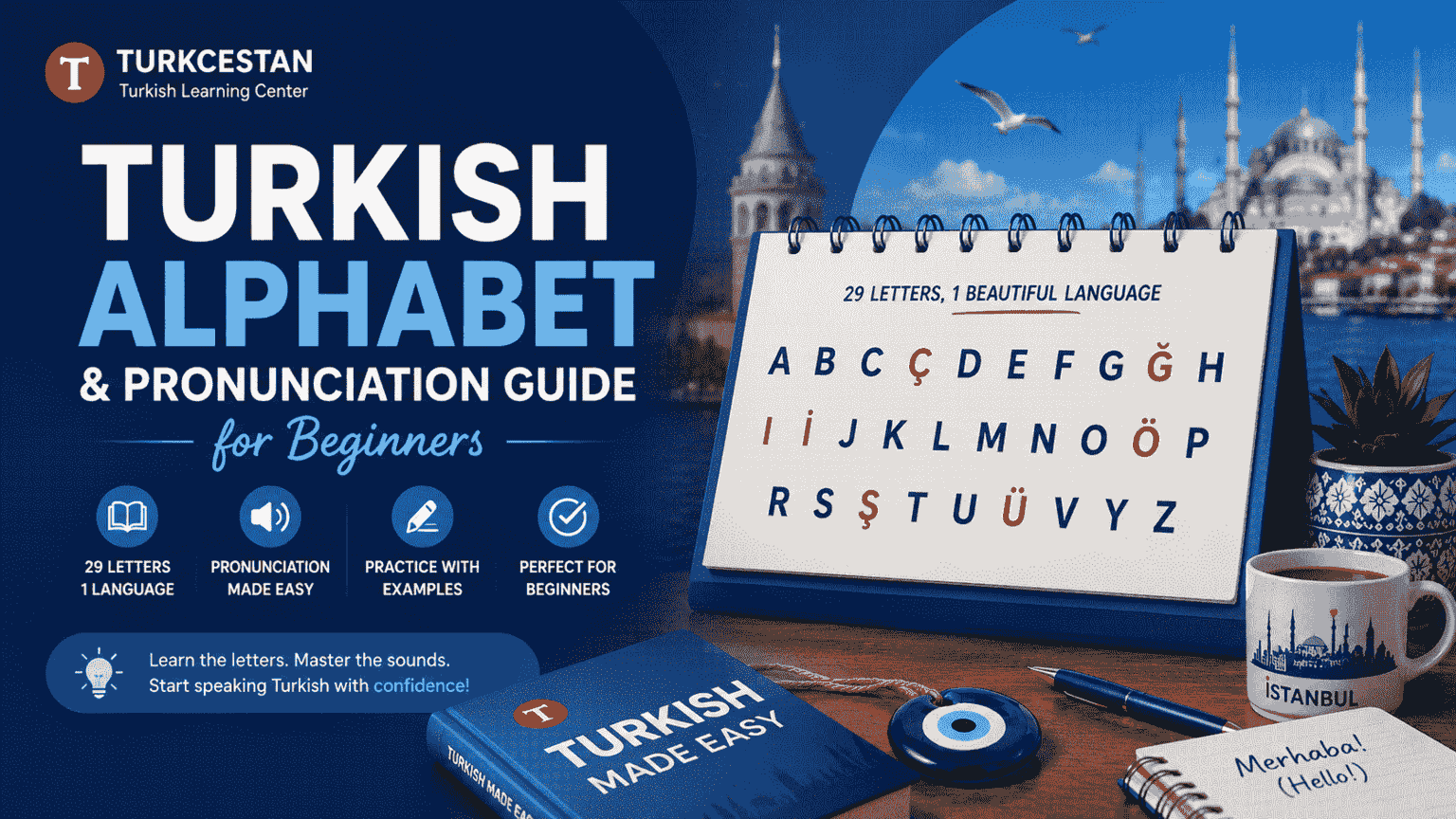
Turkish Alphabet & Pronunciation Guide
The Turkish alphabet is one of the easiest writing systems in the world to learn. Unlike English, Turkish is a highly phonetic language, which means words are pronounced almost exactly as they are written. Once you learn the alphabet and a few pronunciation rules, you’ll be able to read thousands of Turkish words correctly—even if you don’t know their meanings yet.
Whether you’re learning Turkish for travel, work, study, or daily life, mastering the alphabet is the first and most important step. This complete guide explains every Turkish letter, pronunciation rules, common mistakes, useful vocabulary, and practical examples to help you build a strong foundation.
Before you begin, you can check your current level by taking our Free Online Turkish Level Test. After studying this guide, continue improving your pronunciation with our free Turkish lessons on YouTube.
The Turkish Alphabet
The Turkish alphabet consists of 29 letters. It is based on the Latin alphabet but includes several unique letters that may look unfamiliar to English speakers.
| Total Letters | Vowels | Consonants |
|---|---|---|
| 29 | 8 | 21 |
The Turkish alphabet:
A B C Ç D E F G Ğ H I İ J K L M N O Ö P R S Ş T U Ü V Y Z
Unlike English, Turkish does not use the letters Q, W, or X in native Turkish words.
Why is Turkish easier than English?
English has many irregular pronunciations. For example, the letters in through, though, and thought sound completely different. Turkish is much more consistent. Once you know each letter’s sound, you can read almost every Turkish word correctly.
Special Turkish Letters
Most Turkish letters are familiar, but the following letters require special attention.
| Letter | Pronunciation | Example | Meaning |
|---|---|---|---|
| Ç | ch | Çay | Tea |
| Ş | sh | Şeker | Sugar |
| C | j | Cam | Glass |
| Ğ | Soft G | Dağ | Mountain |
| Ö | German ö | Öğretmen | Teacher |
| Ü | German ü | Ülke | Country |
| I | Short neutral vowel | Işık | Light |
| İ | ee | İnsan | Person |
How to Pronounce Each Special Letter
Ç
The letter Ç is always pronounced like the ch in chair.
- Çay (Tea)
- Çocuk (Child)
- Çanta (Bag)
Ş
The letter Ş is always pronounced like the sh in shoe.
- Şeker (Sugar)
- Şehir (City)
- Şarkı (Song)
C
Unlike English, Turkish C sounds like the English J.
- Cam (Glass)
- Cevap (Answer)
- Cuma (Friday)
Ğ (Soft G)
The famous Turkish letter Ğ is often called the Soft G. It usually isn’t pronounced as a separate sound. Instead, it lengthens the vowel before it.
| Word | Meaning | Pronunciation Tip |
|---|---|---|
| Dağ | Mountain | Lengthen the “a” |
| Yağ | Oil | Lengthen the “a” |
| Soğuk | Cold | Soft transition |
Good news: You don’t need to force yourself to pronounce “Ğ.” Native speakers simply extend the previous vowel naturally.
⚠️ Common Mistake
Many English speakers pronounce Ğ like the English letter G. This is incorrect. In most Turkish words, the Soft G simply lengthens the vowel before it.
Turkish Vowels
Turkish has 8 vowels. Learning them correctly will dramatically improve your pronunciation because vowels determine the rhythm and harmony of Turkish words.
| Letter | Pronunciation | Example | Meaning |
|---|---|---|---|
| A | father | Araba | Car |
| E | bed | Ev | House |
| I | short neutral vowel | Işık | Light |
| İ | machine | İsim | Name |
| O | go | Okul | School |
| Ö | German ö | Öğrenci | Student |
| U | rule | Uzun | Long |
| Ü | German ü | Ülke | Country |
Unlike English, Turkish vowels are always pronounced clearly and consistently. There are almost no silent vowels.
Understanding Turkish Vowel Harmony
One of the most important pronunciation and grammar rules in Turkish is vowel harmony. It helps words flow naturally and makes Turkish sound smooth.
When suffixes are added to a word, their vowels usually change to match the last vowel of the word.
| Word | Plural |
|---|---|
| Kitap | Kitaplar |
| Ev | Evler |
| Çocuk | Çocuklar |
| Göz | Gözler |
Don’t worry if this looks difficult now. You’ll naturally become familiar with vowel harmony as you learn more vocabulary.
Learning Tip
Instead of memorizing grammar rules, listen to native speakers and repeat complete words. Your brain will gradually recognize vowel harmony automatically.
Turkish Consonants
Most Turkish consonants sound very similar to English. However, a few letters are pronounced differently.
| Letter | English Sound |
|---|---|
| B | b |
| D | d |
| F | f |
| K | k |
| L | l |
| M | m |
| N | n |
| P | p |
| R | rolled lightly |
| S | s |
| T | t |
| V | v |
| Y | y |
| Z | z |
Word Stress in Turkish
In many Turkish words, the stress naturally falls on the last syllable.
| Word | Meaning |
|---|---|
| Kitap | Book |
| Öğretmen | Teacher |
| Türkiye | Türkiye |
| Arkadaş | Friend |
There are exceptions, especially city names and borrowed words, but stressing the last syllable is a good habit for beginners.
Common Pronunciation Mistakes
English speakers often make the same pronunciation mistakes when learning Turkish.
- Reading C like “k”.
- Pronouncing Ş as “s”.
- Ignoring the difference between I and İ.
- Trying to pronounce Ğ like a hard G.
- Adding extra sounds that do not exist in Turkish.
- Using English pronunciation rules when reading Turkish words.
⚠️ Remember
Read Turkish exactly as it is written. Avoid guessing pronunciation based on English spelling.
Practice Reading These Words
| Turkish | English |
|---|---|
| Merhaba | Hello |
| Türkiye | Türkiye |
| Öğretmen | Teacher |
| Şehir | City |
| Çocuk | Child |
| Arkadaş | Friend |
| Güzel | Beautiful |
| Kitap | Book |
Read these words slowly at first. Focus on pronouncing every letter clearly. As your confidence grows, increase your speed while maintaining accurate pronunciation.
Mini Dialogue: Introducing Yourself
Practice this simple conversation aloud. Reading and speaking together will improve both your pronunciation and confidence.
A: Merhaba! (Hello!)
B: Merhaba! Nasılsınız? (Hello! How are you?)
A: İyiyim, teşekkür ederim. Siz nasılsınız? (I’m fine, thank you. How are you?)
B: Ben de iyiyim. Memnun oldum. (I’m fine too. Nice to meet you.)
A: Ben de memnun oldum. (Nice to meet you too.)
Pronunciation Challenge
Try reading these words aloud three times. Focus on every letter and don’t rush.
| Word | Meaning |
|---|---|
| Çocuk | Child |
| Şemsiye | Umbrella |
| Öğretmen | Teacher |
| Üniversite | University |
| Türkiye | Türkiye |
| Güzel | Beautiful |
| Arkadaş | Friend |
| Teşekkür ederim | Thank you |
Did You Know?
Most Turkish children learn to read within a few months because Turkish spelling is highly phonetic. Once you know the alphabet, you can correctly pronounce almost every new word you see.
Quick Quiz
1. Which Turkish letter sounds like “sh”?
A) Ç
B) Ş
C) C
Answer: B) Ş
2. Which letter usually lengthens the previous vowel?
A) G
B) Ğ
C) H
Answer: B) Ğ
3. How many letters are there in the Turkish alphabet?
A) 26
B) 28
C) 29
Answer: C) 29
4. Which letters do not exist in native Turkish words?
A) Q, W and X
B) J, K and L
C) B, D and F
Answer: A) Q, W and X
5. In general, where is the stress placed in Turkish words?
A) First syllable
B) Middle syllable
C) Last syllable
Answer: C) Last syllable
Improve Your Pronunciation Every Day
Reading is only the first step. To speak Turkish naturally, you should also listen to native speakers every day. Even 10–15 minutes of regular listening practice can significantly improve your pronunciation and confidence.
Watch our free Turkish lessons on YouTube for pronunciation practice, grammar explanations, vocabulary, listening exercises, and real-life conversations.
▶ Watch Free Turkish Lessons on YouTube
Check Your Turkish Level
Wondering how much Turkish you already know? Take our free online placement test and discover your CEFR level from A1 to C1.
✓ Take the Free Online Turkish Level Test
Continue Learning Turkish
Now that you’ve learned the Turkish alphabet and pronunciation rules, continue building your Turkish step by step with these beginner-friendly lessons.
- Beginner’s Guide
- Common Turkish Words & Phrases
- Turkish Grammar Basics
- Turkish Listening Practice
- Turkish Reading Practice
- Turkish Culture & Traditions
Final Thoughts
Learning the Turkish alphabet is one of the fastest and most rewarding steps in your language journey. Because Turkish pronunciation follows consistent rules, you’ll quickly gain confidence reading signs, menus, books, and everyday conversations.
Practice reading aloud every day, listen to native speakers, and don’t worry about making mistakes. Consistent practice is the key to becoming fluent in Turkish.
Good luck, and iyi çalışmalar! (Happy studying!)
Continue Learning Turkish
Excellent! You can now read and pronounce the Turkish alphabet correctly.
The next step is to build your everyday vocabulary with the most useful Turkish words and phrases.
⬅ Previous Lesson
Beginner’s Guide
Review the fundamentals of learning Turkish and refresh the essential tips for beginners.
➡ Next Lesson
Common Turkish Words & Phrases
Learn the most common Turkish words, greetings, and everyday expressions to start communicating with confidence.